\n\n\n\n Products归档 - Page 2 of 2 - Vornet Valve 838209&ev=PageView&noscript=1" />
jessamynlee@vornetvalve.com / jessamyn@vornetvalve.com 📞 +86-17888190118 🌐 EN  |  🇷🇺 RU

3-Way Ball Valve L-Port vs T-Port: Which Flow Pattern Do You Need?

📌 What You’ll Learn:

The critical differences between L-port and T-port 3-way ball valves — flow path geometry, Cv ratings, port isolation, mixing vs diverting capability, pressure drop characteristics, industry-specific selection recommendations, actuation and control considerations, and material/seat selection for your application.

📋 Key Takeaways

  • L-Port valves divert flow between two outlets with a 90° rotation, offering multiple flow paths.
  • T-Port valves connect all three ports simultaneously, enabling mixing or shut-off capability.
  • L-Port designs suit diverting applications; T-Port works best for blending or full-flow needs.
  • Material, pressure rating, and actuation type are critical for 3-way ball valve performance.
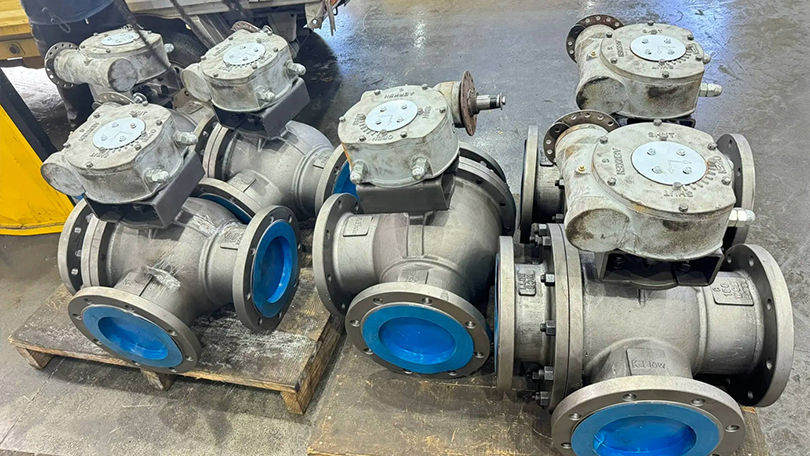
3-way ball valve L-port vs T-port selection guide

furthermore, This 3-way ball valve selection guide covers this 3-way ball valve selection guide explains the critical differences between L-port and T-port flow patterns and when to use each configuration. Every engineer who has specified a 3-way ball valve for flow diversion or mixing has encountered the L-port versus T-port decision. The difference is a single internal passage configuration — but that choice determines whether the valve diverts, selects, mixes, or shuts off. Choosing wrong means either a pressure drop that starves a downstream process, or cross-contamination between streams that compromises product quality.

additionally, The distinction is entirely in the ball’s internal flow path. In an L-port ball valve, the ball has a single L-shaped passage that connects the common port to one of two outlet ports at a time. The port arrangement forms a 90-degree turn inside the ball, which creates a pressure drop but provides positive shutoff on one port while flow passes through the other.

In a T-port ball valve, the ball has a T-shaped passage that connects all three ports simultaneously when fully open, or can connect the common port to both outlets at once. The straight-through path in one position offers full-port flow equivalent to a 2-way ball valve, while the T-configuration allows mixing flow from two inlets into one outlet.

Here is why this matters in practice: an L-port valve specified for a manifold selector service where the operator needs to isolate a dead leg will work perfectly — the L-port blocks one port entirely. But that same L-port, if installed in a blending application where two parallel pumps need to feed into a common header, will create a 90-degree pressure drop that the pump may not have headroom to overcome. The T-port handles this with a straight-through path. Understanding this single geometric distinction is the foundation of every selection decision that follows.

3 way ball valve: 3-Way Ball Valve Selection Guide: L-Port Ball Valve

Design and Operating Principle

An L-port 3-way ball valve features a ball with a single L-shaped bore. The ball rotates 90 degrees to shift flow from one port to another. At any position, the common port (usually the bottom port) is connected to one of the two outlet ports while the third port is positively isolated. The ball’s L-shaped passage creates a 90-degree flow path in both operating positions.

ParameterL-Port Specification
Flow Path90-degree turn at all open positions
Port BlockingOne port fully isolated at each position
Flow Coefficient (Cv)55-65% of equivalent 2-way ball valve
Number of Flow Positions2
Mixing CapabilityNo — cannot connect two inlets to one outlet
Shutoff PositionYes — all ports blocked at intermediate position

Where L-Port Ball Valves Perform Best

Manifold selector service — Selecting between two parallel filters, heat exchangers, or pumps while isolating the offline unit for maintenance.

Tank switching — Diverting product flow from one storage tank to another without interrupting the pipeline. Common in oil terminals, chemical storage farms, and refinery intermediate tanks.

Instrument isolation — Switching calibration gas sources to analyzers or selecting between sample points in a process analyzer system.

CIP/SIP circuits — Clean-in-place and sterilize-in-place systems where cleaning solution must be directed to specific equipment trains.

Where L-Port Valves Hit Their Limits

Mixing and blending — The L-port cannot connect two inlet streams to a single outlet.

High-viscosity fluids — The 90-degree flow turn creates a pressure drop that thick fluids struggle to overcome.

Slurry service — The L-shaped passage has a dead zone at the corner where solids can accumulate.
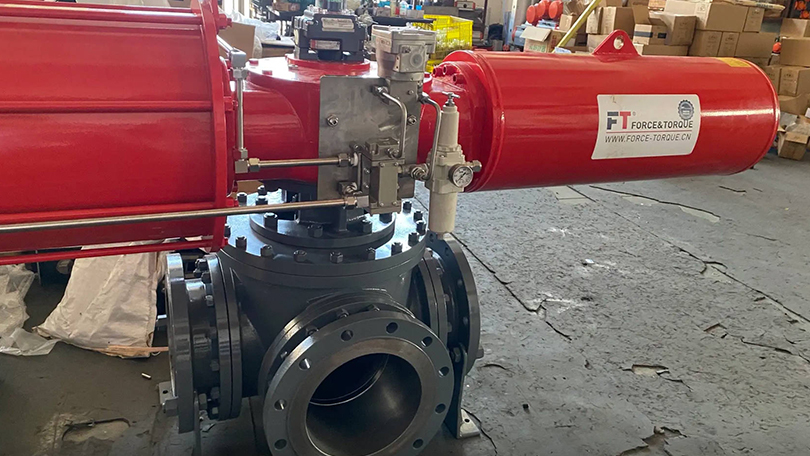
L-port ball valve design and flow path diagram

3. T-Port Ball Valve — Mixing and Full-Port Configuration

Design and Operating Principle

A T-port 3-way ball valve features a ball with a T-shaped bore. In the full open position, the T port aligns to create a straight-through path between two opposite ports while simultaneously connecting the third port. This configuration enables three distinct operating modes: full-through flow (straight path, no turn), diverting flow (common to one outlet), and mixing flow (two inlets to one outlet).

ParameterT-Port Specification
Flow PathStraight-through in one position, 90° turn in others
Port BlockingNo port isolated — all three connected
Flow Coefficient (Cv)80-95% of equivalent 2-way (straight-through)
Number of Flow Positions3
Mixing CapabilityYes — two inlets to one outlet
Shutoff PositionNo — all ports remain connected

Three Operating Positions of a T-Port Valve

Position 1: Straight-Through (Flow Path A ↔ B) — The T bore aligns to create a straight-through passage between two opposite ports. Flow passes with minimal restriction.

Position 2: Right Divert (Common C ↔ Port A) — Flow enters the common port and exits through one side port.

Position 3: Left Divert (Common C ↔ Port B) — Flow diverts to the opposite side port for alternating flow direction.

Where T-Port Ball Valves Perform Best

Continuous mixing and blending — Combining two product streams into a single pipeline. Common in chemical blending, fuel blending, and polymerization processes.

Heat exchanger circuits — Switching flow between parallel heat exchanger tubes or bypassing a fouled exchanger.

Pump recirculation — Directing pump discharge to either the process line or back to the suction tank during startup.

4. Side-by-Side Comparison Matrix

FactorL-PortT-Port
Flow Path90° turn in all positionsStraight-through position available
Cv Rating55-65% of 2-way80-95% of 2-way
Port IsolationOne port fully blockedAll ports connected
Mixing CapableNoYes
Diverter CapableYes — primary functionYes — secondary function
Pressure DropHigher (permanent 90° turn)Lower (straight-through option)
Slurry SuitabilityPoor — solids accumulateBetter — straight path available
Cost Factor1.0x (baseline)1.2-1.5x

L-port and T-port comparison matrix for 3-way ball valves

5. Industry-by-Industry Selection Guide

IndustryApplicationRecommendedReason
Oil & GasWell test manifoldL-PortPositive isolation of unused wellhead
Oil & GasPipeline pig launcherL-PortIsolation of launcher barrel
RefiningCatalyst regeneration switchingT-PortContinuous flow with zero dead-leg
ChemicalReactant blending circuitT-PortMixing two feed streams
Power GenerationCooling water filter switchL-PortSelect between duty/standby filters
Water TreatmentBackwash filter sequenceL-PortIsolate filter vessel during backwash
PharmaceuticalCIP solution routingL-PortDead-leg prevention
Food & BeverageProduct blending stationT-PortMix multiple ingredients
HVACChiller bypass circuitT-PortProportional flow control
StorageTank farm manifoldL-PortSelect tank, isolate others

6. Actuation and Control Considerations

Both L-port and T-port valves can be operated with a standard 90-degree quarter-turn handle. For automated operation, pneumatic rack-and-pinion actuators or electric multi-turn actuators are available. The actuator must be sized for the highest seat load position — typically the closed port at full differential pressure for L-port, or all three ports simultaneously for T-port in mixing position.

For both L-port and T-port valves, a three-position limit switch box (or two individual switches with cam adjustment) is required to indicate which flow path is active. Standard two-switch boxes only indicate open/closed — for multi-port valves, specify a box with three adjustable cams.
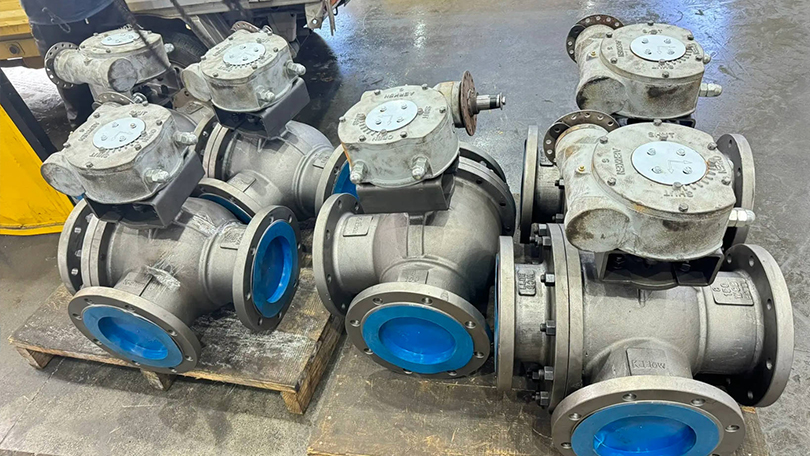
3-way ball valve actuation and material selection guide

7. Materials, Seats, and Pressure Ratings

Body Material Selection

MaterialStandardTemp RangeApplication
WCB (Carbon Steel)ASTM A216-29°C to 425°CGeneral purpose
LCC (Low Temp)ASTM A352-46°C to 345°CLow-temp hydrocarbon
CF8M (316 SS)ASTM A351-254°C to 815°CCorrosive fluids
Duplex 2205ASTM A995-50°C to 300°COffshore, chloride service
Alloy 20ASTM A351-30°C to 400°CSulfuric acid service

Seat Material Selection

Seat MaterialMax TempLeakageBest For
PTFE (Virgin)180°CClass VIGeneral service
RPTFE230°CClass VIHigher temperature
PEEK260°CClass V-VIHigh-temp, high-cycle
Metal (Stellite)680°CClass IV-VFire-safe, abrasive

Looking for industrial 3-way ball valves? Browse our complete ball valve range featuring L-port, T-port and custom configurations for your application.

8. Frequently Asked Questions

Q1: What is the main difference between an L-port and a T-port 3-way ball valve?
A: The ball bore geometry. L-port has a single L-shaped passage that connects the common port to one outlet at a time while blocking the third port. T-port has a T-shaped passage that can connect all three ports simultaneously. L-port is for diverter/selector service; T-port is for mixing service or full-through flow.

Q2: Can an L-port ball valve be used for mixing?
A: No. The L-port geometry only allows flow from the common port to one outlet at a time.

Q3: Can a T-port ball valve be used for diverting?
A: Yes, but the unused port is not fully isolated — it may see partial flow. If positive shutoff of the unused port is required, use an L-port instead.

Q4: Why does my L-port valve have higher pressure drop than expected?
A: L-port valves create a 90-degree flow turn in all positions, reducing Cv to 55-65% of an equivalent 2-way ball valve. Consider a T-port or increase valve size if low pressure drop is critical.

Q5: Which is better for slurry service?
A: T-port is generally better because it offers a straight-through position without corners where solids can accumulate.

Q6: Can 3-way ball valves be automated?
A: Yes. Both L-port and T-port valves can be fitted with pneumatic, electric, or hydraulic actuators sized for the highest seat load position.

Q7: What standards apply to 3-way ball valves?
A: API 6D (pipeline valves), ASME B16.34 (pressure-temperature rating), API 598 (pressure testing), API 607 (fire test), and ISO 17292 (metal ball valves).

Q8: What is the typical delivery time for 3-way ball valves?
A: Standard carbon steel L-port (NPS 1/2-6, Class 150-600): 2-4 weeks. Stainless steel T-port (NPS 2-8): 3-6 weeks. Exotic alloy (Class 900+): 8-14 weeks. All standards reference ASTM International.

Need a 3-Way Ball Valve for Your Application?

Vornet Valve manufactures L-port and T-port 3-way ball valves in carbon steel, stainless steel, and alloy steel — NPS 1/2″ to 24″, Class 150 to 2500. Pneumatic, electric, and manual actuation available.

Get a Quote →

API 600 vs API 602 Gate Valve: Complete Specification and Selection Guide

📋 Key Takeaways

  • API 600 governs bolted bonnet steel gate valves for general refinery and pipeline service.
  • API 602 covers compact forged steel gate, globe, and check valves for smaller-bore applications.
  • API 600 valves suit larger sizes and higher pressures; API 602 fits compact, high-pressure lines.
  • Selection depends on size range, pressure class, temperature limits, and material specifications.

furthermore, Every piping engineer who specifies gate valves for a project has encountered the choice between API 600 and API 602. At first glance, the two standards appear to cover the same product — steel gate valves with rising stems and bolted bonnets. But the differences in wall thickness, material traceability, shell design, pressure-temperature ratings, and quality assurance requirements are substantial enough that selecting the wrong standard can result in an under-specified valve that fails in service, or an over-specified valve that wastes capital budget. For a complete overview of gate valve types and how to choose between them, see our gate valve selection guide.

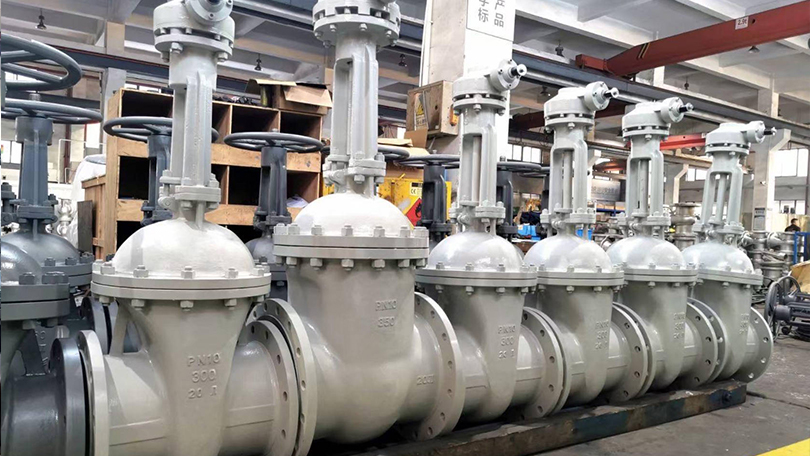
additionally, The distinction begins with scope. API 600 covers heavy-duty, bolted-bonnet steel gate valves for petroleum and natural gas industry applications, primarily in cast steel construction, from NPS 4 through NPS 24 (and larger for special applications). These are the gate valves you find on mainline pipelines, refinery process units, power plant steam systems, and critical isolation points where reliability over decades of service is non-negotiable.

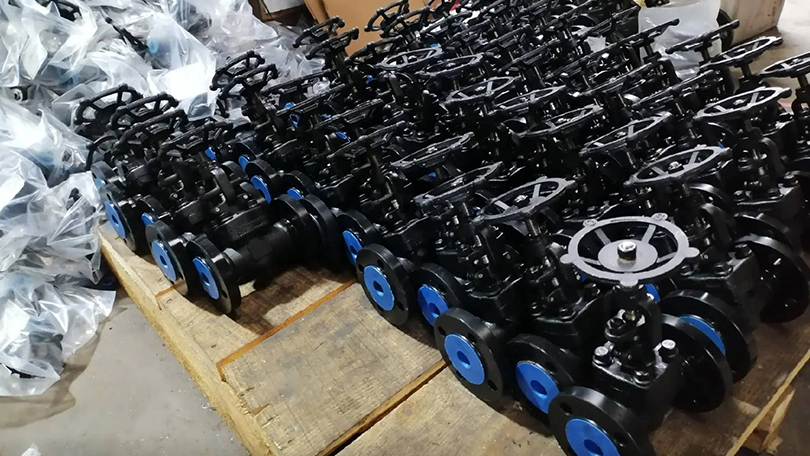
API 602 covers compact, forged steel gate valves for the same petroleum and natural gas industries, but in smaller sizes — NPS 4 and smaller. These valves use forged steel components rather than castings, giving them superior material density and grain structure at the cost of a more limited size range. They are the workhorses of instrument connections, small-bore bypass lines, drain and vent valves, and high-pressure auxiliary systems.

Here is why this matters in practice: specifying an API 600 valve for a NPS 1 drain line is not just wasteful — it may be physically impossible due to the large body casting required. Conversely, installing an API 602 compact gate valve in a NPS 8 mainline where API 600 is the code-required standard could result in a wall thickness inadequate for the mechanical and thermal stresses of the service. Understanding the design envelope of each standard is the foundation of every correct gate valve specification.

Api 602 vs api 600 gate valve: 2. API 600 Gate Valve — The Heavy-Duty Bolted Bonnet Standard

Design and Construction Philosophy

API 600 (Steel Gate Valves — Flanged and Butt-Welding Ends, Bolted Bonnets) is the most widely referenced gate valve manufacturing standard in the hydrocarbon processing industry. The standard defines minimum requirements for body wall thickness, shell design, bonnet bolting, stem connections, seat design, and material traceability.

The defining characteristics of API 600 gate valves include:

  • Cast steel or forged steel body construction (cast is typical for NPS 6 and above; forged is permitted for smaller sizes)
  • Bolted bonnet design with a minimum specified number and diameter of bonnet studs
  • Minimum body wall thickness requirements that exceed ASME B16.34 standard wall by 10-20% for corrosion allowance
  • Integral or renewable seats with minimum seat ring thickness and specific seal width requirements
  • Rising stem with backseat design for stem seal maintenance under pressure
  • Minimum stem diameter requirements to prevent stem bending under differential pressure
  • Full material traceability with documented chemical and mechanical properties

Design Envelope (Vornet Valve Product Range)

ParameterAPI 600 Specification
Size RangeNPS 2″ – 24″ (DN 50 – 600)
Pressure ClassClass 150 – 2500 (PN 16 – 420)
Body ConstructionCast steel (standard), Forged steel (NPS 2-4)
Bonnet TypeBolted bonnet (standard), Pressure seal (Class 900+)
Wall ThicknessASME B16.34 minimum + 10-20% corrosion allowance
Seat TypeIntegral or renewable (threaded-in or welded)
Stem DesignRising stem with backseat, lubricated or non-lubricated
Wedge TypeSolid wedge, flexible wedge, or split wedge per API 600

API 600 Gate Valve design and construction - Vornet Valve

Where API 600 Gate Valves Perform Best

Refinery process units — Crude distillation, FCC, hydrocracker, and reformer units require API 600 gate valves with the corrosion allowance and material traceability that API 600 mandates.

Mainline pipeline isolation — API 600 valves on cross-country pipelines and transmission lines provide the mechanical integrity required for both normal operation and emergency shutdown scenarios.

Power plant steam systems — Main steam, reheat steam, and feedwater isolation where high pressure (up to Class 2500), high temperature (up to 650°C), and thermal cycling demands heavy-duty construction.

Emergency shutdown (ESD) valves — Safety-critical isolation points where zero-leakage under fire conditions is required.

Where API 600 Valves Are Not Suitable

Small-bore instrument and auxiliary lines — The cast body construction for sizes NPS 2 and below is mechanically excessive and cost-prohibitive.

Socket-weld or threaded end connections — API 600 primarily covers flanged and butt-weld end valves.

3. API 602 Gate Valve — The Compact Forged Steel Standard

Design and Construction Philosophy

API 602 (Compact Steel Gate Valves — Flanged, Threaded, Welding, and Extended Body Ends) covers the smaller end of the gate valve spectrum. Originally developed as a rationalization of the many different compact gate valve designs used in the industry, API 602 provides a unified standard for forged steel gate valves that are lighter, more compact, and more economical than their API 600 counterparts in the same size range.

The defining characteristics of API 602 gate valves include:

  • Forged steel body construction in all sizes — superior grain structure, no casting porosity, and full traceability from the ingot to the finished forging
  • Compact face-to-face dimensions that reduce piping stress and allow installation in tight piping layouts
  • Threaded, socket-weld, flanged, or butt-weld ends with full coverage of small-bore piping connection types
  • Bolted bonnet or welded bonnet designs available
  • Minimum wall thickness based on ASME B16.34 standard wall (does not include extra corrosion allowance)
  • Integral seats machined directly into the body forging (no renewable seat rings)
  • Reduced material and manufacturing cost compared to API 600 in the same size range

Design Envelope (Vornet Valve Product Range)

ParameterAPI 602 Specification
Size RangeNPS 1/4″ – 4″ (DN 8 – 100)
Pressure ClassClass 150 – 2500 (PN 16 – 420)
Body ConstructionForged steel (exclusively)
Bonnet TypeBolted bonnet or welded bonnet
Wall ThicknessASME B16.34 standard wall (no additional allowance)
Seat TypeIntegral seat (machined into body forging)
End ConnectionsFlanged (RF/RTJ), Socket Weld, Threaded (NPT/BSPT), Butt Weld
Wedge TypeSolid wedge (standard), Flexible wedge (optional)

API 602 Gate Valve compact forged steel design - Vornet Valve

Where API 602 Gate Valves Perform Best

Bypass and equalization lines — Small-bore lines around larger valves — browse forged API 602 gate valves, pumps, and control valves where the gate valve provides isolation during warm-up or pressure equalization.

Instrument root valves — Isolation at the tap point for pressure gauges, level transmitters, flow meters, and analyzers.

Drain and vent valves — At low points in piping systems where condensate must be drained, and at high points where air must be vented.

Sample connections — Points where process fluid must be extracted for laboratory analysis.

High-pressure auxiliary systems — Hydraulic power units, seal oil systems, and gas boost compressors where working pressures exceed Class 1500 but line sizes are NPS 2 or smaller.

api 600 vs api 602 gate valve: 4. Side-by-Side Comparison Matrix

Comparison FactorAPI 600 Gate ValveAPI 602 Gate Valve
Size RangeNPS 2 – 24 (larger on request)NPS 1/4 – 4
Body ConstructionCast steel (typical), forged permittedForged steel exclusively
Wall ThicknessB16.34 + 10-20% corrosion allowanceB16.34 standard wall
Seat DesignIntegral or renewableIntegral only
Stem DiameterMinimum specified per standardSmaller — compact design
Face-to-FacePer ASME B16.10 (long pattern)Short pattern or manufacturer std
End ConnectionsFlanged, Butt WeldFlanged, SW, NPT, BW
Corrosion Allowance≥ 2 mm (0.08 in) typicalNone — limited to B16.34 minimums
Cost Factor (NPS 2-4)1.4 – 2.0x1.0x (baseline)
Weight (NPS 3, Class 600)~45 kg (cast body)~18 kg (forged body)

API 600 vs API 602 Gate Valve comparison chart - Vornet Valve

5. The Size Overlap Zone — NPS 2 to NPS 4

The most common source of confusion in gate valve specification is the size overlap between NPS 2 and NPS 4, where both API 600 and API 602 valves are available. In this zone, the engineer must evaluate the specific service requirements to determine which standard is appropriate.

Choose API 600 in the overlap zone when: The service is corrosive (corrosion allowance needed), the valve is in critical safety or emergency shutdown path, the operator requires renewable seats for maintenance, or the process fluid contains erosive particles.

Choose API 602 in the overlap zone when: Space and weight constraints are critical (skid-mounted equipment, offshore platforms), the service is non-corrosive (clean hydrocarbon, instrument air, water), or cost reduction is a primary project driver.

Decision FactorAPI 600API 602
Corrosive service (H₂S, CO₂, acid)✅ Yes❌ No
Fire-safe / ESD service✅ YesWith restrictions
Socket-weld or threaded ends❌ Not standard✅ Yes
Weight-sensitive (offshore, skid)❌ Heavy✅ Light
High cycle (>500 cycles/year)✅ Yes⚠️ Verify stem design
Renewable seats required✅ Yes❌ Integral only
Budget constraint❌ Higher cost✅ Lower cost

6. Industry-by-Industry Selection Guide

IndustryApplicationSizeStandardReason
Oil & Gas Gas UpstreamWellhead isolationNPS 2-4API 602Forged body for HPHT; compact spacing
RefiningMain process isolationNPS 10-24API 600High-temp, corrosive, heavy-wall
RefiningInstrument root valvesNPS 1/2-1API 602Socket-weld ends; compact
PetrochemicalReactor feed lineNPS 6-16API 600Thermal cycling; hydrogen service
PipelineMainline block valveNPS 16-24API 600High pressure; ESD capable
Power GenerationMain steam isolationNPS 8-20API 600Class 1500-2500; creep-resistant
Power GenerationBoiler drainNPS 1-2API 602Forged body for frequent draining
ChemicalChlorine serviceNPS 1-2API 602Forged body eliminates porosity
OffshorePlatform utility headerNPS 2-4API 602Weight critical; crack resistance

API 600 vs API 602 industry selection guide - Vornet Valve

7. Pressure-Temperature Ratings and Wall Thickness

Both API 600 and API 602 reference ASME B16.34 for pressure-temperature ratings, but API 600 requires additional wall thickness beyond the ASME B16.34 standard wall. This extra thickness does not increase the pressure-temperature rating number — both standards at Class 600 have the same maximum allowable working pressure at the same temperature.

ClassMax Pressure @ 100°FAPI 600 (NPS 6)API 602 (NPS 2)B16.34 Std
150285 psig0.36″ / 9.1 mmN/A0.28″ / 7.1 mm
300740 psig0.48″ / 12.2 mm0.33″ / 8.4 mm0.38″ / 9.7 mm
6001,480 psig0.63″ / 16.0 mm0.45″ / 11.4 mm0.52″ / 13.2 mm
9002,220 psig0.81″ / 20.6 mm0.56″ / 14.2 mm0.66″ / 16.8 mm
15003,705 psig1.00″ / 25.4 mm0.72″ / 18.3 mm0.84″ / 21.3 mm
25006,170 psig1.38″ / 35.1 mm0.98″ / 24.9 mm1.16″ / 29.5 mm

Note: API 600 thickness values include built-in corrosion allowance; API 602 values follow ASME B16.34 standard wall. In the NPS 2-4 overlap zone, the actual wall thickness of an API 600 valve can be 30-50% greater than an API 602 valve of the same size and class.

8. Bonnet Designs: Bolted vs. Pressure Seal vs. Welded

Bolted Bonnet (Both Standards)

The most common bonnet design for both API 600 and API 602 gate valves. The bonnet is secured to the body with stud bolts and nuts, with a gasket providing the pressure seal. The bolted bonnet allows access to internal components for inspection and repair without removing the valve from the line.

Pressure Seal Bonnet (API 600 Only, Class 900+)

For API 600 valves in Class 900 and above, the pressure seal bonnet design is common. Higher pressure forces the seal ring tighter against the body. The bonnet is retained by a yoke or segmented ring rather than heavy stud bolts. Preferred for high-pressure steam service in power plants.

Welded Bonnet (API 602 Only)

API 602 allows a welded bonnet design for non-serviceable applications where the valve is expected to be replaced rather than repaired. The welded bonnet eliminates the potential leak path at the bonnet gasket and reduces overall valve weight by 15-25%.

9. Materials, Trim, and Seat Design

Body and Bonnet Materials

MaterialStandardAPI 600 UseAPI 602 Use
WCB (Carbon Steel)ASTM A216General refinery, pipelineGeneral auxiliary, drain
WCC (Carbon Steel)ASTM A216Higher-strength applicationsHigh-pressure small bore
LCB/LCC (Low Temp)ASTM A352Cryogenic, cold climateLow-temp instrument lines
WC6/WC9 (Cr-Mo)ASTM A217High-temp steam (650°C)High-temp small bore
CF8/CF8M (SS)ASTM A351Corrosive serviceCorrosive auxiliary lines
Duplex 2205ASTM A995Offshore, chloride serviceOffshore small bore

Seat Design Comparison

API 600: Allows both integral seats (machined directly into the body casting) and renewable seats (threaded-in or welded seat rings). Renewable seats are preferred for mainline valves where seat damage can be repaired by replacing the seat ring.

API 602: Typically uses integral seats machined directly into the body forging. The forged body has superior material density compared to castings, reducing the risk of seat-face porosity, but the integral seat cannot be replaced.

10. Procurement Specification Checklist

#Specification ItemYour Data
1Pipe size (NPS): Under 4″ → API 602; 4″+ → API 600________
2Pressure class (150 / 300 / 600 / 900 / 1500 / 2500)________
3End connection type________
4Body material and ASTM grade________
5Is the fluid corrosive?________
6Is space or weight critical?________
7Are renewable seats required?________
8Operating temperature range________
9Wedge type: Solid / Flexible / Split________
10Bonnet type: Bolted / Pressure seal / Welded________
11NACE MR0175 / MR0103 required?________
12Fire-safe certification? (API 6FA / API 607)________
13Fugitive emissions? (ISO 15848-1)________
14Actuation type________
15Testing per API 598________

Need API 600 or API 602 gate valves? View our gate valve product range with full API specification compliance, various trim options, and custom engineering support.

11. Common Specification Mistakes to Avoid

After reviewing hundreds of gate valve RFQs, our engineering team has identified five recurring specification errors that lead to delivery delays, cost overruns, or incorrect valve selection:

Mistake 1: Specifying API 600 for small-bore non-critical drain lines

Using API 600 for NPS 1-2 instrument root valves or drain valves wastes budget. API 602 forged steel valves at 40-60% lower cost provide adequate service life for non-corrosive auxiliary applications. Reserve API 600 for mainline process isolation.

Mistake 2: Omitting NACE MR0175 requirement for sour service

If the process fluid contains H2S above the NACE threshold (partial pressure >0.05 psia), both body material and trim must comply with NACE MR0175/ISO 15156. For API 600, specify WCB with hardness maximum HRC 22. For API 602, specify A350 LF2 Class 1. Missing this spec can cause sulfide stress cracking within months.

Mistake 3: Ignoring bonnet gasket material for thermal cycling

Standard spiral-wound graphite gaskets perform well for steady-state operation. For frequent thermal cycling (refinery start-up/shutdown cycles), specify flexible graphite with a stainless steel inner ring — it maintains seal integrity through differential thermal expansion and prevents fugitive emissions.

Mistake 4: Confusing pressure class with wall thickness

A Class 600 API 602 valve and a Class 600 API 600 valve have the same pressure-temperature rating per ASME B16.34 — but the API 600 body is 10-20% thicker. The extra thickness is NOT for higher pressure; it is corrosion allowance. In corrosive service, the API 602 valve may require upgrading to a higher class or a more corrosion-resistant material to compensate for the thinner wall.

Mistake 5: Skipping fire-safe certification for ESD valves

Emergency shutdown gate valves in hydrocarbon service require fire-safe certification per API 6FA or API 607. API 600 valves are inherently fire-safe due to their metal-to-metal seat design. API 602 compact valves may need a fire-safe seat design upgrade — verify before specifying for ESD duty.

Best practice: Submit a complete valve datasheet with your RFQ — fill in the 15-point checklist above and include the process fluid composition, operating temperature range, and any special coating requirements. This eliminates the most common sources of specification error.

For technical support on API 600 or API 602 gate valve specifications, contact our valve engineering team.

12. Frequently Asked Questions

Q1: What is the main difference between API 600 and API 602 gate valves?
A: API 600 covers heavy-duty bolted-bonnet gate valves (NPS 2-24, typically cast steel) with extra wall thickness for corrosion allowance. API 602 covers compact forged steel gate valves (NPS 1/4-4) with standard wall thickness. API 600 is for critical process service; API 602 is for auxiliary and small-bore service.

Q2: Can API 602 replace API 600 in NPS 2 to NPS 4?
A: Not automatically. API 602 is acceptable if the service is non-corrosive, does not require renewable seats, and space/weight constraints apply. For corrosive, fire-safe, or critical safety service, API 600 is correct.

Q3: Why does API 600 require thicker walls than API 602?
A: API 600 provides 10-20% extra wall thickness above ASME B16.34 standard for long-term corrosion allowance in refinery and hydrocarbon service.

Q4: What is the maximum size for API 602 gate valves?
A: API 602 officially covers sizes NPS 4 and smaller. For NPS 6 and above, API 600 or ASME B16.34 standard values apply.

Q5: Do API 600 and API 602 use the same pressure-temperature ratings?
A: Yes — both reference ASME B16.34. The extra wall thickness in API 600 does not increase the pressure rating; it provides corrosion allowance.

Q6: Are API 600 valves always cast steel?
A: No. API 600 permits both cast and forged steel construction. In smaller sizes (NPS 2-4), forged steel API 600 valves are available.

Q7: What is the typical delivery time?
A: API 602 standard valves: 1-3 weeks. API 600 cast steel (NPS 4-12, Class 150-600): 4-8 weeks. API 600 high-pressure or exotic trim: 10-16 weeks.

Q9: Do I need NACE MR0175 for API 600 or API 602 gate valves?
A: If the fluid contains H2S (sour service per NACE MR0175/ISO 15156), YES. For API 600, specify WCB body with HRC 22 max and trim per NACE. For API 602, specify A350 LF2 Class 1 or A182 F316 with appropriate hardness limits. Both standards can be supplied with NACE compliance — specify it clearly in your RFQ.

Q8: How do I identify the wall thickness difference?
A: Measure body wall with an ultrasonic thickness gauge at the body centerline. API 600 will be 10-20% greater than B16.34 standard wall; API 602 matches standard wall.

API 6D Forged Steel Ball Valve – Professional Industrial Valve Guide

📌 Quick Summary:

API 6D forged steel ball valves are quarter-turn isolation valves designed per API Specification 6D for oil & gas pipelines, petrochemical plants, refineries, and power generation. Available in sizes 1/2″ to 48″ (DN15–DN1200) with pressure ratings from Class 150 to 2500, these valves offer floating or trunnion-mounted ball designs in forged materials including A105 carbon steel, F304, and F316 stainless steel. Fire-safe certified per API 607, they provide reliable bidirectional sealing, double block and bleed capability, and NACE compliance for sour service environments.

📋 Key Takeaways

  • API 6D forged steel ball valves comply with the strictest pipeline valve standard for pressure containment, sealing, and fire safety.
  • Forged steel (A105, F304, F316) offers superior strength, uniformity, and resistance to shock loading compared to cast steel alternatives.
  • Available in floating ball design (1/2″–8″) for lower pressure and trunnion-mounted design (6″–48″) for high-pressure Class 600+ service.
  • NACE MR0175/MR0103 compliant materials available for sour (H₂S) oil and gas environments.
  • All API 6D ball valves from Vornet Valve are 100% hydrostatically tested per API 598 and fire-safe certified per API 607.
API 6D Forged Steel Ball Valve

Quick Answer: What Is an API 6D Ball Valve?

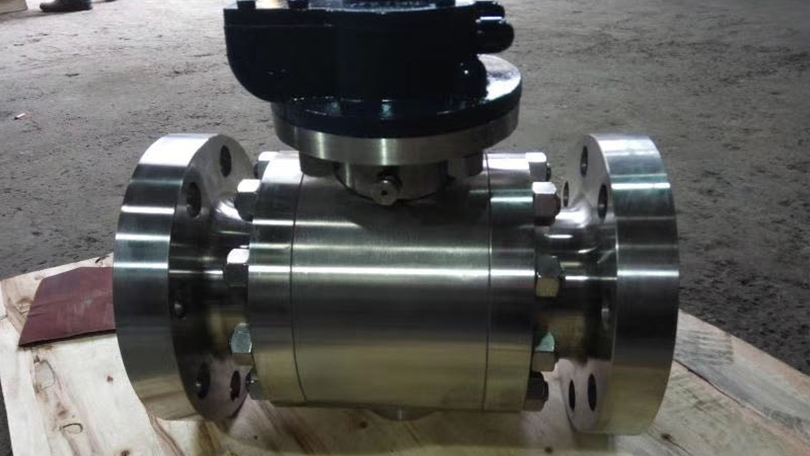
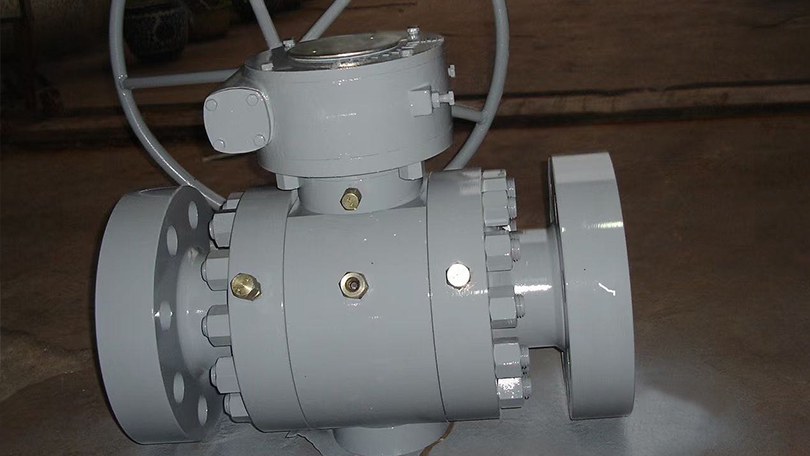
An API 6D ball valve is a quarter-turn valve designed per API Specification 6D for pipeline and piping system isolation in oil & gas, petrochemical, and power industries. Available in sizes 1/2″–48″ (DN15–DN1200) with pressure ratings from Class 150 to 2500, API 6D ball valves can be floating or trunnion mounted, in forged or cast steel materials, with flanged, butt-weld, or socket-weld end connections.

Key Specifications at a Glance

ParameterAPI 6D Ball ValveSpecification
Size Range1/2″ – 48″ (DN15 – DN1200)ASME B16.10 face-to-face
Pressure Class150, 300, 600, 900, 1500, 2500ASME B16.34
MaterialsForged A105, F304, F316; Cast WCB, CF8, CF8MASTM standards
End ConnectionsFlanged (ASME B16.5), Butt-Weld, Socket WeldASME B16.5 / B16.25
OperationLever, Gear, Pneumatic, Electric ActuatorISO 5211 mounting
Design StandardAPI 6D, ASME B16.34API / ASME
Fire-SafeAPI 607 / ISO 10497 certifiedAPI 607

What Is API 6D Standard?

API 6D is the American Petroleum Institute specification for pipeline and piping valves used in the petroleum and natural gas industries. It covers the design, manufacturing, testing, and documentation of ball valves, gate valves, check valves, and plug valves. The standard ensures valves meet stringent requirements for pressure containment, sealing performance, and operational reliability in demanding oil and gas applications.

Key requirements of API 6D include: hydrostatic and pneumatic shell testing per API 598, fugitive emission testing, fire-safe design per API 607, anti-static devices, double block and bleed (DBB) capability for trunnion-mounted valves, and full material traceability throughout the manufacturing process.

API 6D Ball Valve Design Features

Floating Ball Design

In smaller API 6D ball valves (typically 1/2″ to 8″), a floating ball design is used where the ball moves between two seat rings. Upstream pressure pushes the ball against the downstream seat to create a seal. This design is simple, cost-effective, and suitable for lower-pressure applications up to Class 600.

Trunnion Mounted Design

For larger API 6D ball valves (6″ and above) or high-pressure applications (Class 600+), trunnion mounted design is preferred. The ball is anchored by top and bottom trunnions, reducing seat stress and ensuring reliable operation even at high pressures. This design supports double block and bleed (DBB) functionality, allowing the valve body cavity to be vented while the valve is in both open and closed positions.

Fire-Safe Design

API 6D ball valves can be certified fire-safe per API 607. In the event of a fire destroying the soft seats, a secondary metal-to-metal seal activates to prevent leakage. This is a critical requirement for oil and gas facilities handling flammable media. Vornet Valve API 6D ball valves are fire-safe certified as standard.

Forged Steel vs Cast Steel API 6D Ball Valves

Forged vs Cast Steel API 6D Ball Valves

API 6D ball valves are manufactured in both forged steel and cast steel constructions, each offering distinct advantages depending on the service conditions:

PropertyForged SteelCast Steel
Manufacturing ProcessHot forging produces directional grain flowMolten metal poured into mold
Strength & DurabilitySuperior — 30–50% higher tensile strengthGood — but porosity risk exists
Pressure RatingsClass 150 to 2500 (full range)Typically Class 150 to 1500
Size Range1/2″ to 24″ (larger sizes available on request)2″ to 48″+
Shock/Vibration ResistanceExcellent — ideal for cyclic servicesModerate — brittle fracture risk
Material UniformityDense, consistent grain structureVariable; risers required
NACE CompatibilityExcellent (A105, F304, F316)Good (WCB, CF8, CF8M with NACE trim)
CostHigher for same size/classLower — economical for large diameters
Best ApplicationsHigh-pressure gas, sour service, critical safetyLarge-diameter pipelines, general service

Material Grades for API 6D Forged Steel Ball Valves

Material selection is critical for API 6D ball valve performance and longevity. Below are the standard forged steel grades available:

ASTM A105 — Forged Carbon Steel

A105 is the most common forged carbon steel grade for general-service API 6D ball valves. Suitable for oil, gas, water, and steam applications across all pressure classes. Temperature range: -29°C to 425°C (-20°F to 800°F). A105 is NACE MR0175 compliant when properly heat-treated and hardness-controlled.

ASTM A182 F304 / F304L — Forged Stainless Steel

F304 (304 stainless steel) offers excellent corrosion resistance in oxidizing environments including nitric acid, organic chemicals, and food processing. F304L (low carbon variant) prevents sensitization during welding, making it ideal for welded end connections. Temperature range: -254°C to 815°C. Common in chemical processing, pharmaceutical, and food & beverage industries.

ASTM A182 F316 / F316L — Forged Molybdenum Stainless Steel

F316 contains 2–3% molybdenum, providing superior pitting and crevice corrosion resistance compared to F304. Ideal for chloride-containing environments such as seawater, brine, and chemical processing with sulfuric or phosphoric acids. F316L (low carbon) is preferred for welded construction. NACE MR0173 compliant for sour service up to certain H₂S partial pressures.

ASTM A350 LF2 — Low Temperature Carbon Steel

LF2 is the standard low-temperature grade for API 6D ball valves, impact-tested to -46°C (-50°F). Used in cryogenic gas processing, LNG terminals, and cold-climate pipeline installations.

Material GradeTypeMax TemperatureTypical Applications
A105Forged Carbon Steel425°COil, gas, water, steam — general service
LF2Low Temp Carbon Steel-46°C to 345°CLNG, cryogenic, cold climate
F304/LForged 304 SS815°COxidizing chemicals, food, pharma
F316/LForged 316 SS815°CSeawater, chlorides, chemical processing
F51Duplex SS315°CSour gas, offshore, high chloride
F55Super Duplex SS315°CExtreme corrosion, subsea

Size Ranges and End Connections

API 6D forged steel ball valves are manufactured in standard sizes from NPS 1/2″ to NPS 24″ (DN15 to DN600) as forged constructions. Larger sizes up to 48″ are available in cast steel or fabricated designs. The most common end connections include:

  • Flanged Ends (ASME B16.5): Class 150, 300, 600, 900, 1500, and 2500 raised-face (RF) or ring-type joint (RTJ) configurations. Standard facing per ASME B16.5.
  • Butt-Weld Ends (ASME B16.25): Beveled ends for direct welding to pipe — ideal for high-integrity pipeline systems that eliminate flange leakage paths.
  • Socket Weld Ends (ASME B16.11): For smaller sizes (1/2″ to 2″) in high-pressure applications where threaded connections are not permitted.
  • Threaded Ends (NPT/BSP): For small-bore general service applications (1/2″ to 2″).

Pressure Ratings for API 6D Ball Valves

API 6D ball valves are rated per ASME B16.34 pressure-temperature tables. The maximum working pressure depends on the material grade and temperature:

ClassA105 @ 100°FF304 @ 100°FF316 @ 100°FTest Pressure (Shell)
150290 psi275 psi275 psi435 psi
300750 psi720 psi720 psi1,125 psi
6001,500 psi1,440 psi1,440 psi2,250 psi
9002,250 psi2,160 psi2,160 psi3,375 psi
15003,750 psi3,600 psi3,600 psi5,625 psi
25006,250 psi6,000 psi6,000 psi9,375 psi

Higher temperatures reduce the allowable working pressure per ASME B16.34 de-rating curves. Always consult the pressure-temperature chart for your specific material grade.

NACE Compliance for Sour Service

API 6D ball valves used in sour oil and gas environments containing hydrogen sulfide (H₂S) must comply with NACE MR0175/ISO 15156 (upstream) or NACE MR0103 (downstream). Key requirements include:

  • Hardness Control: Maximum hardness of 22 HRC for carbon steel and 26 HRC for stainless steel wetted parts.
  • Material Selection: A105 with normalized and tempered heat treatment; F316/L for corrosion-resistant alloys; Inconel 625 or 825 for critical trim components.
  • Heat Treatment: Full anneal or normalize-and-temper to eliminate residual stresses that could cause sulfide stress cracking (SSC).
  • Testing: Hardness testing per ASTM E10 or E18 on all pressure-containing parts and trim.
  • Trim Selection: NACE-compliant soft seats (PTFE, reinforced PTFE, PEEK) and metal seat backups.

Vornet Valve supplies API 6D ball valves with full NACE compliance documentation, including material test reports (MTRs) and hardness certification.

Applications of API 6D Ball Valves

API 6D Ball Valve Applications

API 6D ball valves are used across a wide range of industrial applications:

  • Oil & Gas Pipelines: On-off isolation, pigging operations, emergency shutdown, compressor station isolation
  • Petrochemical Plants: Process line isolation, reactor feed, product transfer, cracking unit feed
  • Power Generation: Cooling water systems, fuel gas supply, steam isolation, turbine bypass
  • Refineries: Crude oil processing, product storage, loading/unloading, hydrotreater feed
  • Offshore Platforms: Subsea isolation, topside piping, wellhead control, chemical injection
  • LNG & Cryogenic: Liquefaction unit isolation, storage tank isolation, vaporizer feed
  • Mining & Minerals: Slurry isolation, leaching circuit isolation, process water

Materials of Construction

API 6D Ball Valve Materials

API 6D ball valves are available in a variety of materials to suit different service conditions. Contact Vornet Valve for a complete material availability list and recommendation for your application.

MaterialTypeCommon Applications
A105Forged Carbon SteelGeneral service, oil, gas, water
F304 / F316Forged Stainless SteelCorrosive media, chemical processing
WCBCast Carbon SteelStandard pipeline applications
CF8 / CF8MCast Stainless SteelCorrosive environments, food processing
LF2Low Temp Carbon SteelLow temperature service (-46°C)

API 6D vs API 600: Key Differences

Both API 6D and API 600 are common valve standards, but they serve different purposes:

  • API 6D: Covers ball, gate, check, and plug valves for pipeline service. Includes both cast and forged valves.
  • API 600: Covers only cast steel bolted bonnet gate valves for petroleum and gas industries. More stringent wall thickness.
  • API 6D includes fire-safe, DBB, and anti-static requirements that API 600 does not.
  • API 600 requires heavier wall construction than API 6D for the same pressure class.

Why Choose Vornet Valve for API 6D Ball Valves?

Vornet Valve is a professional manufacturer of API 6D ball valves serving oil & gas, petrochemical, and power industries worldwide. Our valves are:

  • Manufactured per API 6D, ASME B16.34, and ISO 9001
  • Fire-safe certified per API 607
  • 100% pressure tested per API 598
  • Available with full material traceability and NACE compliance
  • Customizable with various trim materials, seat options, and actuation

Contact Vornet Valve today for competitive pricing and technical support on API 6D ball valves. Check our range of API 6D forged steel ball valves and other certified industrial valve products for oil and gas applications.

Need an API 6D Forged Steel Ball Valve?

Vornet Valve supplies API 6D ball valves in sizes 1/2″ to 48″, Class 150 to 2500, in forged A105, F304, F316, and NACE-compliant materials. Contact our engineering team for sizing, material selection, and pricing.

Request a Quote →

Frequently Asked Questions

What is the difference between API 6D and API 608 ball valves?

API 6D covers pipeline ball valves of all sizes and includes requirements for fire-safe design, anti-static devices, and DBB capability. API 608 covers metal ball valves with flanged or butt-welding ends for general service in smaller sizes (NPS 1/2″ to 12″).

What pressure testing is required for API 6D ball valves?

Per API 598, each API 6D ball valve must pass a hydrostatic shell test (1.5 × rated pressure), hydrostatic seat test (1.1 × rated pressure), and optional pneumatic test. Vornet Valve performs 100% testing on all ball valves before shipment.

Can API 6D ball valves be used for throttling?

No. API 6D ball valves are designed for on-off isolation service. Using them for throttling causes seat and ball damage. For flow control applications, use a control valve or V-port ball valve specifically designed for regulation.

Are API 6D ball valves bidirectional?

Most API 6D floating ball valves are bidirectional, sealing equally from both directions. Some trunnion mounted ball valves with DBB seats are also bidirectional. Vornet Valve can supply API 6D ball valves with bidirectional sealing as standard.

What is the price range of an API 6D forged steel ball valve?

Pricing depends on size, pressure class, material, and actuation. A standard 2″ Class 150 forged steel floating ball valve starts at approximately USD 40. Larger sizes, higher pressure classes, and special materials increase the price. Contact Vornet Valve for a customized quotation based on your specifications.

What is the difference between forged and cast API 6D ball valves?

Forged API 6D ball valves are manufactured by hot-working steel into dense, uniform grain structures, offering superior strength, pressure resistance, and shock tolerance compared to cast valves. Forged valves are preferred for high-pressure (Class 600+), sour service, and critical safety applications. Cast valves are more economical for large diameters (14″+) and general pipeline service.

Are API 6D ball valves NACE compliant?

Yes, API 6D ball valves can be supplied with NACE MR0175 (upstream) or NACE MR0103 (downstream) compliance. This requires controlled hardness (max 22 HRC for carbon steel), appropriate material selection, and certified heat treatment. Vornet Valve offers NACE-compliant API 6D ball valves with full documentation.