
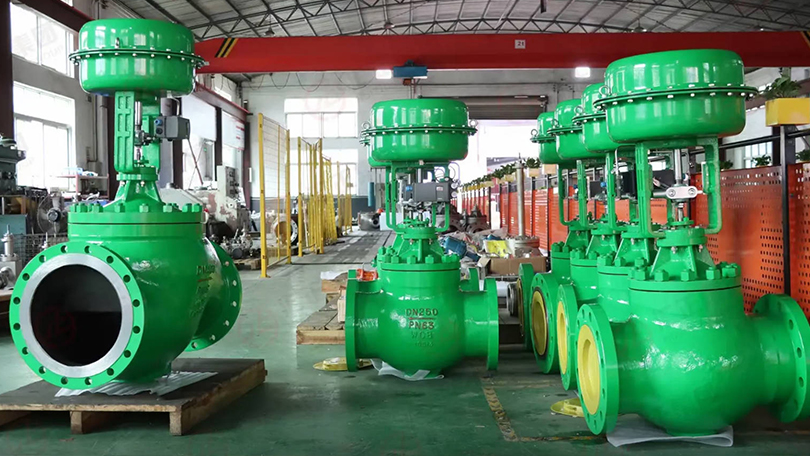
Control Valve Selection Guide: Types, Actuation, Sizing, and How to Choose
📋 Key Takeaways
- Control valve selection starts with calculating required Cv based on process flow rate, pressure drop, and fluid properties.
- Globe valves offer precise throttling control while rotary valves provide higher capacity and lower cost per Cv.
- Actuator type selection considers fail-safe position, response time, and available power sources including pneumatic and electric.
- Material selection must match fluid corrosivity, temperature range, and erosion potential for reliable long-term service life.
What Is a Control Valve?
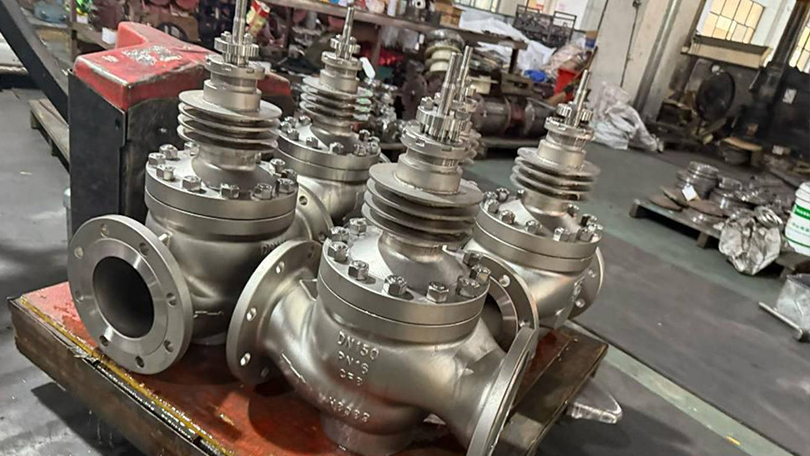
A control valve is a power-operated device that modulates fluid flow in response to a signal from a controller. Specifically, Unlike isolation valves (gate, ball) that only open or close, control valves position the valve trim at any point between fully open and fully closed to maintain process variables — flow rate, pressure, temperature, or level — at set points. This guide covers essential control valve selection information.
Control valves are the final control element in any process control loop. Together with a sensor, transmitter, and controller, they form the closed-loop system that keeps industrial processes running within specification.
Key Components of a Control Valve
- Body — The pressure-containing housing that connects to the piping
- Trim — Internal components (seat, disc/plug, stem, cage) that control flow
- Actuator — Pneumatic, electric, or hydraulic device that positions the trim
- Positioner — Device that compares the control signal to the valve position and adjusts the actuator accordingly
- Accessories — I/P converter, limit switches, solenoid valves, air sets, volume boosters
Main Types of Control Valves
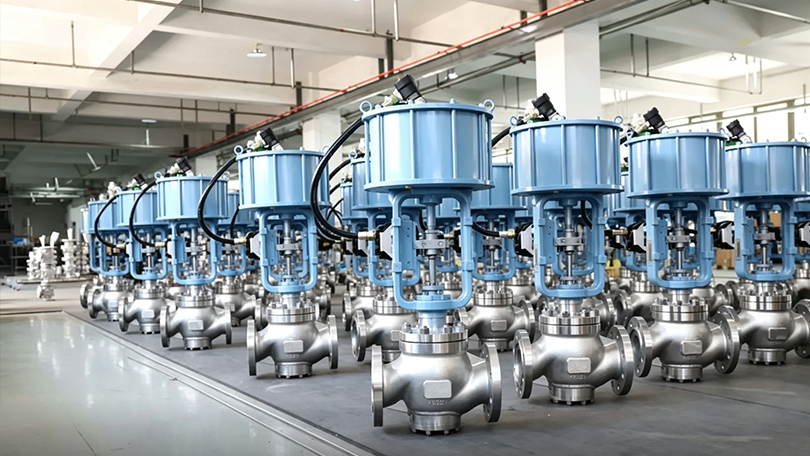
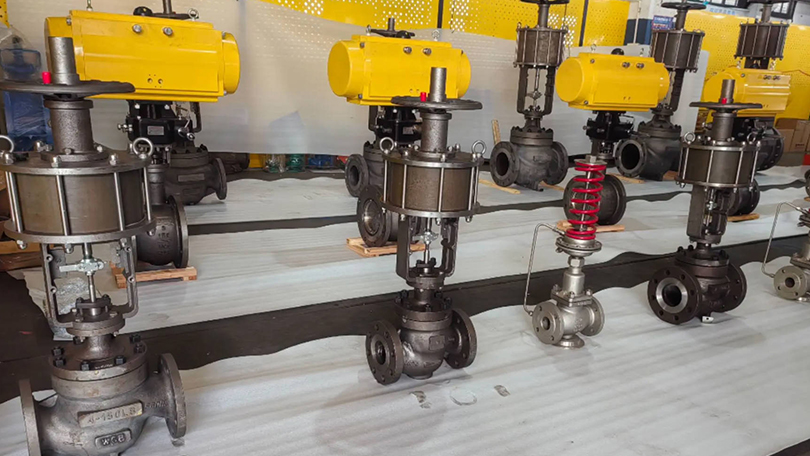
1. Globe Control Valve (Linear Motion)
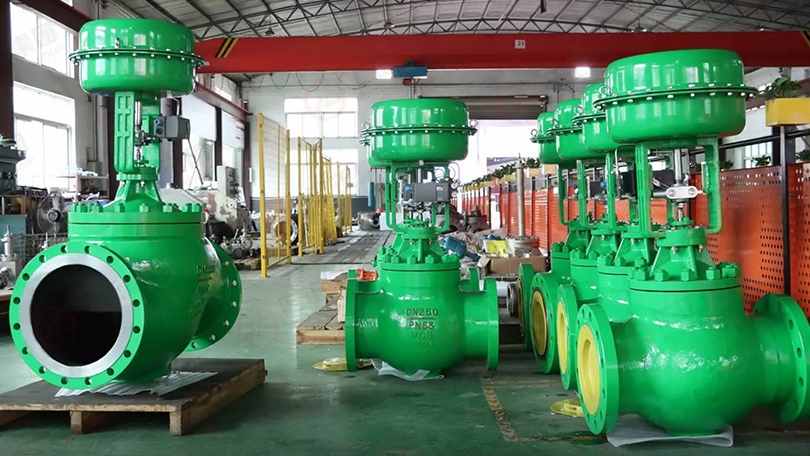
The most common control valve type. Notably, The plug moves linearly against the seat to modulate flow. Available in single-seat, double-seat, cage-guided, and balanced plug designs.
Best for: Precise throttling, high pressure drop, cavitating or flashing service, wide rangeability.
| Subtype | Feature | Application |
|---|---|---|
| Single-seat globe | One seat ring — tight shut-off | Critical control, low leakage requirements |
| Cage-guided globe | Trim guided by a cage — stable at high ΔP | High pressure drop, steam, and erosive service |
| Balanced plug globe | Pressure-balanced trim — lower actuator force | Large valves, high pressure, reduced actuator size |
| Y-pattern globe | 45° angle body — lower flow resistance | High-pressure steam, coking, and high-viscosity fluids |
2. Rotary Control Valve (Quarter-Turn)
Rotary control valves use a rotating element (ball, disc, or plug) to modulate flow. For example, They offer higher capacity and lower cost than globe valves for certain applications.
| Subtype | Feature | Application |
|---|---|---|
| V-port ball valve | V-notch in ball — shearing action | Fibrous slurries, pulp & paper, wastewater |
| Characterized disc (eccentric) | Eccentric rotation — low friction, tight seal | Chemical, pharmaceutical, general service |
| Eccentric plug valve | Rotating plug — erosion resistant | Abrasive slurries, mining, heavy chemical |
3. Diaphragm Control Valve
Uses a flexible diaphragm and weir body design. The diaphragm isolates the fluid from the bonnet and actuator, making it ideal for corrosive, toxic, or sterile fluids.
Best for: Corrosive chemicals, pharmaceutical, food & beverage, water treatment.
4. Control Valve vs. Isolation Valve
| Factor | Control Valve | Isolation Valve (Gate/Ball) |
|---|---|---|
| Primary function | Modulate / regulate flow | Open / close |
| Positioning | Any point 0-100% | Full open or full close |
| Actuator | Positioner + actuator required | Manual or on/off actuator |
| Flow characteristic | Linear / equal % / quick opening | N/A |
| Shut-off class | Class II-VI (control trim) | Class 0 (bubble-tight with soft seat) |
| Cost | 2-5x higher than equivalent isolation valve | Lower |
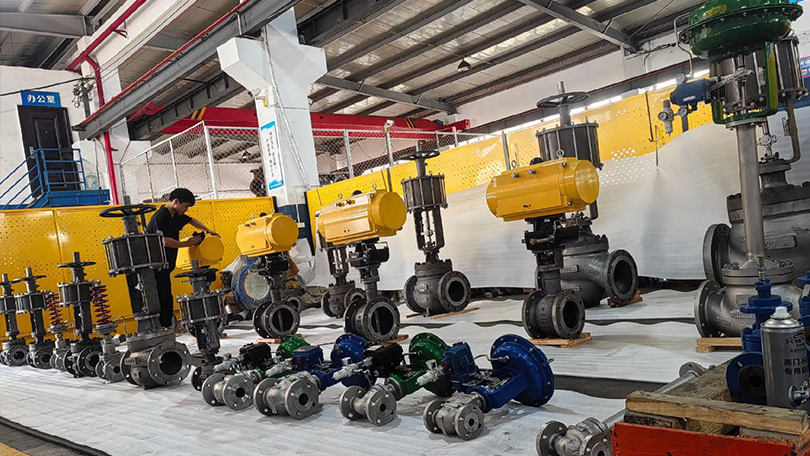
Actuator Selection
Pneumatic Actuators
Most common in process industries. Fast response, low cost, fail-safe (spring-return). Types: diaphragm (linear), piston (linear/rotary), rack & pinion (quarter-turn).
Electric Actuators
No air supply required. Slower response but precise positioning. Ideal for remote locations, clean environments, and where instrument air is unavailable.
Hydraulic Actuators
Highest thrust capacity. Ultimately, Used for very large valves, high-pressure service, and where rapid response with high force is needed. Common in pipelines and hydroelectric plants.
| Feature | Pneumatic | Electric | Hydraulic |
|---|---|---|---|
| Response speed | Fast | Moderate | Fastest |
| Force/thrust | Moderate | High | Very high |
| Fail-safe option | Spring-return (built-in) | Battery backup / capacitor | Accumulator |
| Utility required | Clean, dry instrument air | Electric power | Hydraulic power unit |
| Cost | $ | $$ | $$$ |
| Best for | Most process control applications | Remote/clean areas, precise positioning | High-force, large-valve, critical service |
Control Valve Flow Characteristics
The flow characteristic describes how flow changes relative to valve stem position. This affects loop stability and control range.
- Linear — Flow is proportional to stem position. Best for level control and constant-pressure systems.
- Equal Percentage — Equal changes in stem position produce equal percentage changes in flow. Best for pressure control, high ΔP systems, and when most of the system pressure drop is in the piping.
- Quick Opening — Large flow increase at small openings. Used for on-off service and relief valves.
Control Valve Sizing Fundamentals
Proper sizing prevents cavitation, noise, and premature wear. Key parameters:
- Cv (Flow Coefficient) — Number of US gallons per minute of 60°F water that flow through the valve with a 1 psi pressure drop
- Pressure Drop (ΔP) — Difference between upstream and downstream pressure
- Choked Flow — Maximum flow condition where downstream pressure can no longer increase flow
- FL (Pressure Recovery Factor) — Accounts for valve geometry’s effect on pressure recovery
- Rangeability — Ratio of maximum to minimum controllable flow (typically 30:1 to 100:1 for globe valves)
Control Valve Material Selection
| Service | Body Material | Trim Material |
|---|---|---|
| General chemical, water, steam | WCB / WCC Carbon Steel | 304 SS + Stellite seat |
| Corrosive fluids (acids, caustics) | CF8M / CF3M Stainless Steel | 316L SS, Hastelloy seat |
| High temperature (425-538°C) | WC6 / WC9 Chrome-Moly | Stellite 6, Inconel |
| Sour gas (H₂S service) | NACE-compliant LCC/SS | NACE trim materials |
| High-pressure steam letdown | Cage-guided WC9 | Stellite 6 hardened trim |
| Sanitary / pharmaceutical | 316L SS (Ra ≤ 0.8 μm) | EPDM / PTFE diaphragm |
8-Step Control Valve Selection Method
- Define service conditions — Fluid, temperature, pressure, flow rate (normal/max/min), viscosity, specific gravity
- Determine valve type — Globe (precise control, high ΔP) or rotary (high capacity, lower cost)
- Calculate Cv — Use standard sizing equations per IEC 60534-2-1 or ISA-75.01
- Check for cavitation / flashing — Compare ΔP to allowable pressure drop. Use anti-cavitation trim if needed
- Select flow characteristic — Linear for level control; equal % for pressure and flow control
- Choose body and trim materials — Based on temperature, pressure, corrosion resistance, and erosion
- Size the actuator — Account for required thrust, process pressure forces, packing friction, and safety factor
- Specify accessories — Positioner, I/P converter, solenoid valve, limit switches, air filter regulator
Common Control Valve Applications by Industry
| Industry | Application | Valve Type |
|---|---|---|
| Oil Refining | Crude distillation, FCC, hydrotreating | Cage-guided globe, angle valves |
| Chemical & Petrochemical | Reactor feed, column control, catalyst addition | Globe, V-port ball, diaphragm |
| Power Generation | Feedwater regulation, steam attemperation, turbine bypass | High-pressure globe, angle valves |
| Oil & Gas Production | Wellhead choke, separator level, pipeline pressure | Eccentric plug, globe, rotary |
| Pharmaceutical | Sterile processing, CIP, WFI systems | Diaphragm, full-bore globe |
| Water & Wastewater | Filter control, chemical dosing, pump recirculation | Rotary, globe, eccentric plug |
Need a Control Valve for Your Process?
Vornet Valve supplies globe control valves, V-port ball valves, and eccentric plug valves with pneumatic, electric, or hydraulic actuation. Sizes NPS 1″ to 36″, Class 150 to 2500. Contact our engineering team for sizing assistance.
• What Is a Control Valve? — Types, Features, and Applications
• Globe Valve Complete Guide