
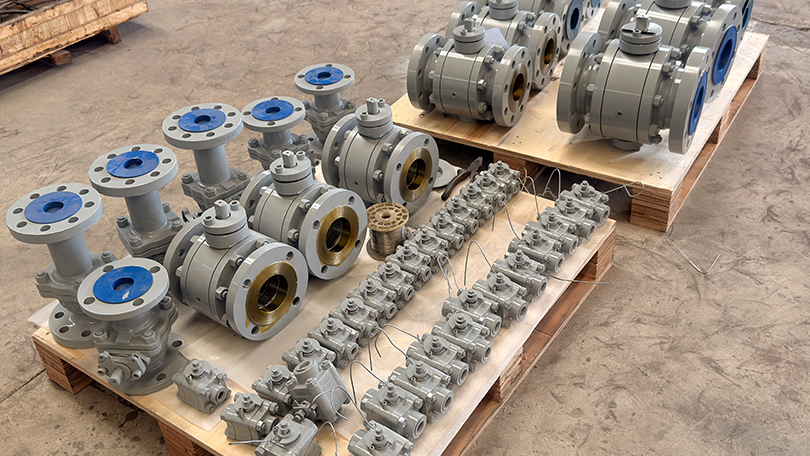
Ball Valve Complete Guide: Types, Selection, Materials, and Applications
📋 Key Takeaways
- Ball valves use a rotating spherical closure element with a straight-through bore for quarter-turn operation.
- Floating ball designs suit lower-pressure applications while trunnion-mounted balls handle pressures exceeding 1500 psi.
- Full-port ball valves minimize pressure drop while reduced-port designs offer cost savings for less demanding services.
- Seat materials including PTFE, reinforced PTFE, and PEEK determine the valve’s temperature range and sealing performance.
This complete ball valve guide covers everything you need to know: ball valve working principle, main types (floating, trunnion, 3-way, V-port), material selection, pressure ratings, standards, applications, and how to choose the right ball valve for your project. Use the links throughout to dive deeper into specific topics.
📖 Table of Contents
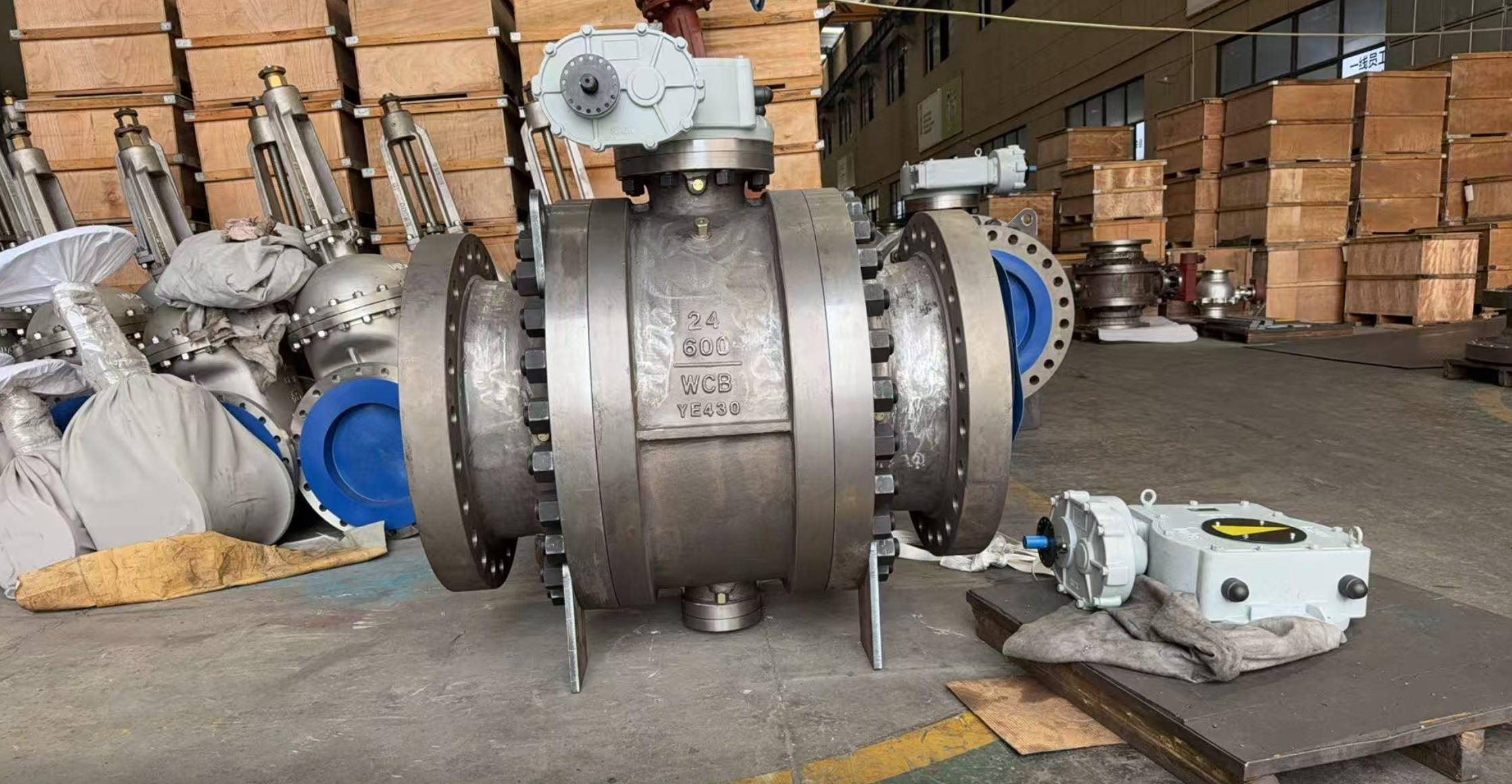
What Is a Ball Valve? — Ball Valve Types
A ball valve is a quarter-turn rotary motion valve that uses a hollow, perforated, and pivoting ball to control flow through it. When the ball’s bore aligns with the pipe axis, flow passes through (open position). When rotated 90 degrees, the solid part of the ball blocks the flow path (closed position). This guide covers essential ball valve types information.
Ball valves are known for their quick shut-off capability, tight sealing, and low operating torque, making them one of the most widely used valve types in industrial fluid control systems.
How Does a Ball Valve Work?
The ball valve operates on a simple principle:
- Open position — The ball’s bore is aligned with the flow path, allowing fluid to pass through with minimal pressure drop
- Closed position — The ball is rotated 90 degrees, presenting a solid face to the flow path, creating a bubble-tight seal
- Partially open — Some ball valve designs (V-port, characterized port) allow throttling control by positioning the ball at intermediate angles
Additionally, Key components include: body, ball, stems (upper and lower), seats (sealing rings), packing, bonnet, and actuator mounting pad.
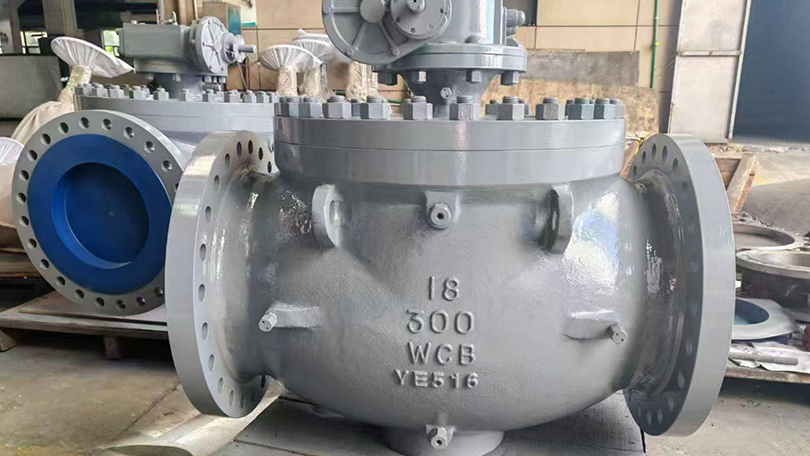
Main Types of Ball Valves
1. Floating Ball Valve
In a floating ball valve, the ball is not mechanically fixed in position. It “floats” between two elastomeric or polymeric seat rings. When pressure is applied from the upstream side, the ball is pressed against the downstream seat, creating a seal.
Best for: Smaller sizes (NPS 1/2″ to 8″), lower pressure classes (Class 150-600), general-purpose applications.
→ Compare floating vs trunnion ball valves in detail →
2. Trunnion Ball Valve
In a trunnion ball valve, the ball is mechanically anchored by a fixed shaft at both the top and bottom (trunnion). Notably, This design absorbs the thrust load generated by line pressure, significantly reducing operating torque and seat wear.
Best for: Large diameters (NPS 4″ to 60″), high-pressure services (Class 600-2500), high-temperature, and critical pipeline isolation applications.
→ Full trunnion ball valve guide →
3. 3-Way and Multi-Port Ball Valves
Three-way ball valves feature a ball with an L-shaped or T-shaped bore that can direct flow between multiple ports. L-port valves divert flow from one inlet to one of two outlets. T-port valves can mix two inlets into one outlet or split one inlet.
Best for: Flow diversion, mixing, switching between pipelines, and batch processing.
→ Full 3-way ball valve guide (L-port vs T-port) →
4. Full Bore vs Reduced Bore Ball Valves
| Feature | Full Bore (Full Port) | Reduced Bore (Venturi) |
|---|---|---|
| Bore diameter | Equal to pipe ID | Smaller than pipe ID (typically 1-2 sizes smaller) |
| Pressure drop | Minimal — same as straight pipe | Higher — venturi effect |
| Pigging capability | Yes — allows pipeline pig passage | No |
| Cost | Higher (larger ball, more material) | Lower (30-40% savings) |
| Torque | Higher | Lower |
| Best for | Pigging, high-flow, viscous fluids | General service, cost-sensitive projects |
5. V-Port Ball Valve
V-port ball valves have a “V” shaped notch cut into the ball. For example, This design provides improved throttling control and shearing action for fibrous or viscous fluids. The flow characteristic is approximately equal percentage, offering good control rangeability.
Best for: Throttling/control applications, pulp and paper, wastewater treatment, viscous fluids.
6. High Temperature Ball Valve
High-temperature ball valves use special material combinations (Inconel 718/625 bodies, Stellite hardfacing, metal seats) to operate reliably at temperatures from 250°C up to 1000°C. These are critical for petrochemical, power generation, and metallurgical applications.
→ High temperature ball valve material guide →
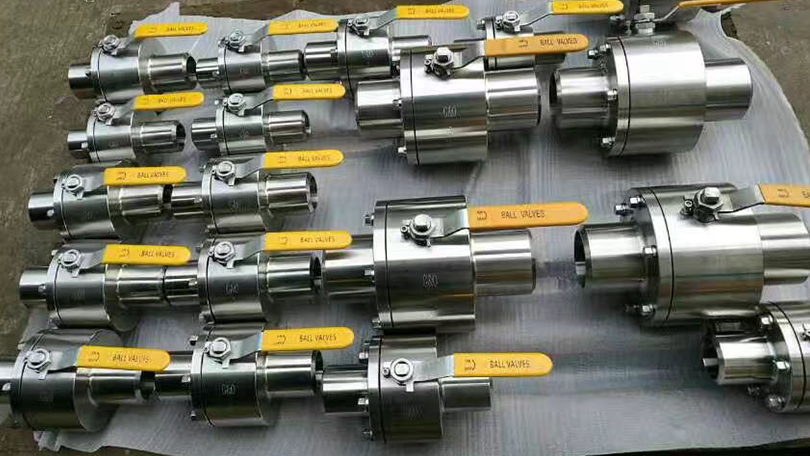
Ball Valve Material Selection
Body Materials
| Material | Standard | Temperature Range | Application |
|---|---|---|---|
| WCB Carbon Steel | ASTM A216 | -29°C to 425°C | General service, oil & gas, water |
| CF8M / CF3M Stainless Steel | ASTM A351 | -196°C to 538°C | Corrosive media, food, chemical |
| F304 / F316 Forged SS | ASTM A182 | -196°C to 538°C | High-pressure, small-bore valves |
| Duplex / Super Duplex SS | ASTM A890 / A995 | -50°C to 315°C | Sour gas, seawater, chloride-rich |
| Inconel 625 / 718 | ASTM B564 | -196°C to 980°C | High-temperature, extreme corrosion |
| Titanium | ASTM B367 / B381 | -196°C to 315°C | Highly corrosive chemical media |
| Monel 400 | ASTM B564 | -196°C to 538°C | Hydrofluoric acid, marine |
| Alloy 20 | ASTM B473 | -196°C to 538°C | Sulfuric acid, chemical processing |
Seat and Seal Materials
| Seat Material | Max Temperature | Key Feature |
|---|---|---|
| PTFE / RPTFE | 200°C | Low friction, chemical resistant, bubble-tight |
| Reinforced PTFE (25% Glass/Carbon) | 232°C | Higher mechanical strength, reduced cold flow |
| PEEK | 260°C | Excellent wear resistance, high strength |
| Nylon | 150°C | Good wear, lower cost |
| Devolite (PPL) | 260°C | Good chemical resistance, high temp |
| Metal-seated (Stellite/SS) | 538-980°C | High temperature, abrasive media, fire-safe |
Ball Valve Standards and Specifications
| Standard | Scope |
|---|---|
| API 6D | Pipeline ball valves — design, manufacturing, and testing for transmission pipelines |
| ASME B16.34 | Pressure-temperature ratings, dimensions, and tolerances |
| ASME B16.5 / B16.47 | Flange dimensions and drilling templates |
| API 598 | Valve inspection and pressure testing |
| ISO 17292 | Metal ball valves for petroleum, petrochemical, and allied industries |
| ISO 5211 | Actuator mounting flange dimensions |
| API 607 / ISO 10497 | Fire-safe testing |
| NACE MR0175 / ISO 15156 | Sour service (H₂S) material requirements |
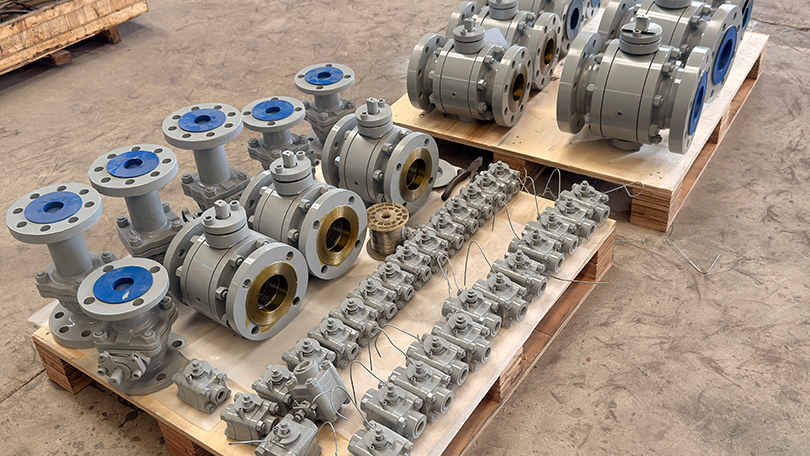
How to Select the Right Ball Valve
- Define operating conditions: Medium (liquid/gas/steam), pressure class, temperature, flow rate
- Choose the valve type: Floating (small, low pressure), trunnion (large, high pressure), 3-way (mixing/diversion), V-port (throttling)
- Select body material: Based on corrosion resistance, temperature range, and cost
- Choose seat material: Based on temperature, sealing requirements, and media compatibility
- Determine end connections: Flanged (ANSI/ASME/DIN), threaded, socket weld, butt weld
- Select bore size: Full bore (low pressure drop, pigging) or reduced bore (cost saving)
- Choose actuation: Manual (handle/gear), pneumatic, electric, or hydraulic
- Check compliance: Ensure the valve meets applicable API/ASME/ISO standards
Common Ball Valve Applications by Industry
| Industry | Application | Preferred Ball Valve Type |
|---|---|---|
| Oil & Gas (Upstream) | Wellhead, flowlines, gathering | Trunnion-mounted, API 6D |
| Oil & Gas (Pipeline) | Transmission, pig launching, isolation | Full-bore trunnion, fire-safe |
| Chemical Processing | Reactor feed, corrosive media handling | Chemically-compatible seat, SS/Alloy body |
| Power Generation | Boiler isolation, steam, cooling water | High-temp metal seat, trunnion |
| Water & Wastewater | Distribution, treatment, filtration | Floating, full-bore, epoxy-coated |
| Pharmaceutical | Clean-in-place, hygienic processing | Full-bore, SS body, clamp ends |
| HVAC | Chilled water, hot water, cooling towers | Floating, 2-way or 3-way |
| Marine | Ballast, seawater cooling, fuel transfer | Duplex SS, trunnion |
Ball Valve Advantages and Limitations
Advantages
- Quick 90-degree quarter-turn operation (open to close)
- Bubble-tight shut-off with soft seats
- Low operating torque compared to gate and globe valves
- Compact design — shorter face-to-face dimensions than gate valves
- Bi-directional sealing capability
- Suitable for automated actuation
- Low pressure drop in full-open position
Limitations
- Not ideal for throttling (unless V-port or characterized design)
- Soft seats limit maximum temperature (PTFE ≈ 200°C; metal seats needed for high temp)
- Can trap cavity pressure with certain media
- More expensive than gate valves for very large diameters (NPS 24+)
Ball Valve vs Other Valve Types
| Factor | Ball Valve | Gate Valve | Globe Valve | Butterfly Valve |
|---|---|---|---|---|
| Operation | 90° quarter-turn | Multi-turn linear | Multi-turn linear | 90° quarter-turn |
| Shut-off | ✅ Bubble-tight | ✅ Tight (metal) | ✅ Excellent | ⚠️ Good (soft seat) |
| Throttling | ❌ Poor (V-port: ⚠️ Fair) | ❌ Poor | ✅ Excellent | ⚠️ Fair |
| Pressure drop | Very low | Low | Moderate-High | Low-Moderate |
| Speed | Fast | Slow | Slow | Fast |
| Size range | NPS 1/2″ to 60″ | NPS 1/2″ to 60″ | NPS 1/2″ to 48″ | NPS 2″ to 120″ |
| Cost (NPS 6″, Class 150) | $$ | $ | $$ | $ |
Ball Valve Maintenance Tips
- Periodically cycle the valve (open-close) to prevent seat sticking
- Check stem packing for leakage — tighten or replace as needed
- Lubricate stem and gearbox per manufacturer schedule
- For high-temperature service, ensure proper thermal cycling procedures
- Replace seat seals every 3-5 years for standard service; more frequently for severe service
- Store spare valve with ball in partially open position (5-10°) to prevent seat deformation
Ball Valve FAQ
Q1: What is the difference between floating and trunnion ball valves?
A floating ball valve has a ball that rests between two seat rings and relies on line pressure to create a seal against the downstream seat. Ultimately, In a trunnion ball valve, the ball is anchored by fixed shafts at top and bottom, absorbing pressure thrust and reducing seat wear. Floating valves suit smaller sizes (NPS 1/2″ to 8″) and lower pressures (Class 150-600). Trunnion valves handle large diameters (NPS 4″ to 60″), high pressures (Class 600-2500), and critical pipeline services. See our trunnion vs floating ball valve guide.
Q2: What is the maximum operating temperature for a ball valve?
For soft-seated ball valves: PTFE/RPTFE seats max 200°C, PEEK seats max 260°C, Devolite/PPL seats max 260°C. For high-temperature service, metal-seated ball valves with Stellite hardfacing operate up to 538°C, and special Inconel body designs with Stellite trim can handle up to 980°C. See our high temperature ball valve guide for details.
Q: Are ball valves suitable for throttling and flow control?
Standard ball valves are designed for on/off isolation. However, V-port ball valves with a V-shaped notch provide an approximately equal-percentage flow characteristic suitable for throttling. For precise control, globe valves or control valves are typically preferred. See our control valve selection guide for a comparison of valve types for throttling service.
Q: When should I choose full bore vs reduced bore ball valves?
Choose full bore for: minimal pressure drop, pipeline pigging, viscous/slurry fluids, and maximum flow. Choose reduced bore for: general service where 30-40% cost savings matter, no pigging requirement, and acceptable higher pressure drop. Full bore is standard in pipeline transmission; reduced bore is common in general industrial applications.
Q: What standards apply to ball valve design and testing?
Key standards include: API 6D (pipeline design and testing), ASME B16.34 (pressure-temperature ratings), API 598 (inspection and testing), ISO 17292 (metal ball valves), API 607 (fire-safe testing), and NACE MR0175 (sour service). All Vornet ball valves are manufactured to these applicable API, ASME, ASTM, and EN standards.
Need a Ball Valve for Your Project?
Vornet Valve supplies floating, trunnion, and 3-way ball valves in sizes NPS 1/2″ to 60″, Class 150 to 2500, in carbon steel, stainless steel, duplex, and exotic alloys. API 6D certified and fire-safe rated.
• Trunnion vs Floating Ball Valve: Complete Comparison
• 3-Way Ball Valve L-Port vs T-Port Guide
• High Temperature Ball Valve Material Guide (250°C-1000°C)
• Industrial Valve Materials & Trim Equivalents Guide
🏭 Looking for a Reliable Ball Valve Manufacturer?
Vornet Valve is a China-based industrial valve manufacturer with over 20 years of experience. We manufacture ball valves to API 6D, ASME B16.34, API 608, and ISO 17292 standards — including floating, trunnion-mounted, 3-way, V-port, and high-temperature ball valves. Available in sizes NPS 1/2″ to 60″, Class 150 to Class 2500, with materials from WCB carbon steel to duplex stainless steel and Hastelloy. Our ball valves are used in oil & gas, LNG, chemical processing, power generation, and marine applications worldwide.
Contact us today for a quote or technical consultation:
- Email: jessamyn@vornetvalve.com
- WhatsApp: +86 17888190118
- Website: www.vornetvalve.com